
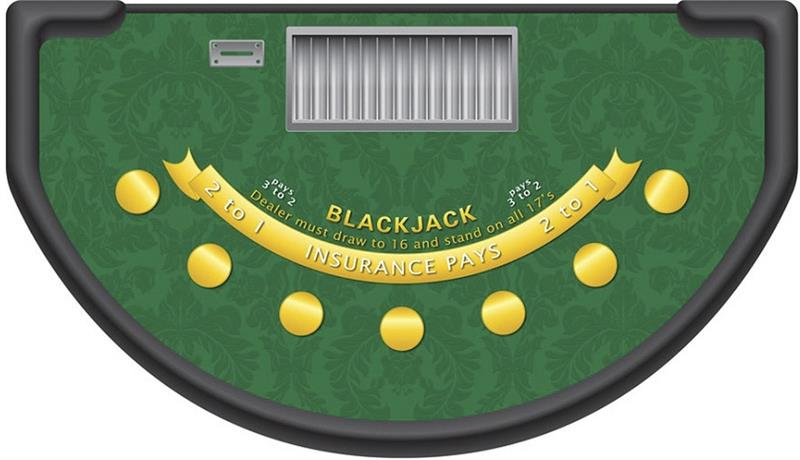
Before placing real money on the line, understanding the blackjack table layout is essential. The table is more than just felt and cards—it’s a structured playing field designed to control the flow of the game, clarify betting rules, and reduce mistakes. Knowing what each area means helps you play confidently, avoid costly errors, and focus on strategy rather than confusion.
Why the Blackjack Table Layout Matters
When real money is involved, every decision counts. A clear understanding of the table layout helps you:
-
Place bets correctly and on time
-
Recognize payout rules instantly
-
Avoid violating table limits or house rules
-
Communicate smoothly with the dealer
Players who ignore the layout often feel rushed or uncertain, which can lead to poor decisions.
Core Parts of a Blackjack Table
A standard blackjack table is designed in a semi-circle, allowing multiple players to face the dealer comfortably. Each section has a specific purpose.
Player Betting Spots
These are clearly marked circles or rectangles on the felt in front of each seat.
-
Each spot belongs to one player
-
Chips must stay inside your betting area
-
Only one hand per spot unless rules allow splits
Placing chips outside these areas may result in a no-play situation.
Dealer Area
The dealer’s section is directly opposite the players and includes:
-
The dealer’s card placement area
-
The shoe or hand-dealt card zone
-
The discard tray
This space is strictly off-limits to players.
Chip Tray
Located in front of the dealer, the chip tray holds house chips arranged by denomination.
-
Players never touch this tray
-
All chip exchanges are handled by the dealer
-
It ensures accurate payouts and smooth game flow
Table Limit Sign and Betting Rules
Every blackjack table displays a table limit sign, usually placed on the dealer’s left or right.
This sign shows:
-
Minimum bet (e.g., $10)
-
Maximum bet (e.g., $500)
Some tables also list rules like:
-
Blackjack payout (3:2 or 6:5)
-
Dealer hits or stands on soft 17
Always check this sign before sitting down.
Insurance and Side Bet Areas
Many tables include additional markings beyond the main betting spots.
Insurance Line
When the dealer shows an Ace, a thin line appears in front of your main bet.
-
Insurance bets are placed here
-
The wager is usually up to half your original bet
-
It pays if the dealer has blackjack
Side Bet Circles
Optional side bets may be printed on the felt, such as:
-
Perfect Pairs
-
21+3
-
Lucky Ladies
These bets have higher house edges and are not required to play standard blackjack.
Card Dealing Zones
The way cards are dealt depends on the casino and table type.
-
Shoe games: Cards come from a multi-deck shoe on the table
-
Hand-dealt games: The dealer deals directly from a shuffled deck
Discarded cards are placed in a visible tray to prevent reuse.
Seating and Player Positioning
Blackjack seating isn’t random—it affects the pace of play.
-
Seats are evenly spaced for clear betting areas
-
The first seat is often called first base
-
The last seat is known as third base
While seat position doesn’t change odds, it can influence how fast decisions are made.
Common Table Layout Variations
Not all blackjack tables look the same. Variations include:
-
Single-deck vs. multi-deck layouts
-
Continuous shuffle machine (CSM) tables
-
High-limit tables with extra space and signage
Despite visual differences, the core layout principles remain consistent.
Mistakes Players Make When Ignoring the Layout
Failing to understand the table layout often leads to:
-
Placing bets too late
-
Confusing side bets with main wagers
-
Misreading payout rules
-
Touching cards or chips incorrectly
These mistakes can slow the game or cost you money unnecessarily.
FAQs
What do the numbers printed on a blackjack table mean?
They usually indicate table limits, payouts, or side bet rules specific to that table.
Can I move my chips after placing a bet?
No. Once cards are dealt, bets are typically locked and cannot be adjusted.
Are side bets mandatory in blackjack?
No. Side bets are completely optional and separate from the main game.
Why does the dealer stand in a specific spot?
The dealer’s position ensures consistent card dealing, chip handling, and rule enforcement.
Does table layout affect blackjack odds?
The layout itself doesn’t change odds, but rules printed on the table—like payout ratios—do.
Can two players share one betting spot?
Generally no. Each betting spot is intended for one player unless the casino allows exceptions.
Is the blackjack table layout the same online?
Online blackjack uses a digital version of the same layout, but chip placement and dealing are automated.
